
At Portobello High School we are committed to developing positive relationships within our school community and believe this to be essential in encouraging the types of behaviour we want to see from our young people. Our ethos of promoting positive relationships and achieving together is underpinned by the following initiatives:
• Achieving Together commitment
•Class Charts
•Stepped Actions
Achieving Together
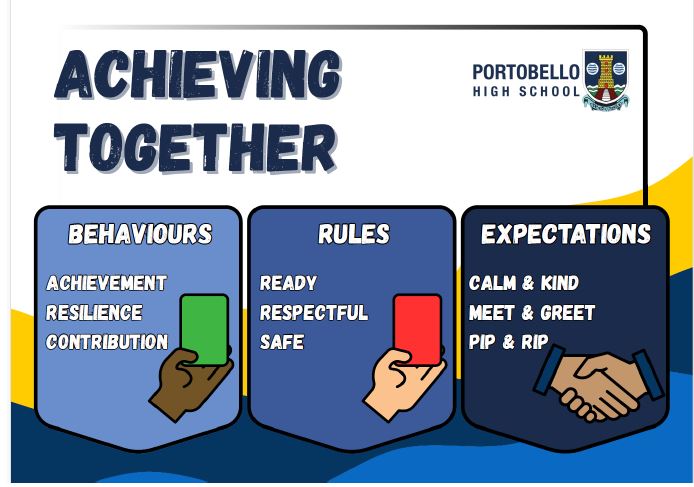
Our Achieving Together policy outlines our school behaviours and rules we want to encourage from our learners as well as the expectations young people can have of their teachers.
Behaviours
These behaviours are at the heart of what Portobello High School encourages students to
develop and demonstrate daily:
•Achievement – Striving for personal and academic success, celebrating progress, and taking pride in learning.
•Resilience – Showing perseverance in the face of challenges, bouncing back from setbacks, and maintaining a positive attitude.
•Contribution – Actively participating in school life, supporting peers, and making a positive impact in the classroom and wider community.
Rules
Simple, clear, and positively framed rules that support our learning environment for
everyone:
•Ready – Arriving on time, equipped, and prepared to learn.
•Respectful – Treating others with kindness, listening actively, and using appropriate language.
•Safe – Acting in ways that protect the wellbeing of self and others, both physically and emotionally.
Expectations
These are the everyday practices from adults that help build strong relationships and a calm
learning environment:
•Calm & Kind – Staff model calm and kind behaviour by responding with consistency, empathy, and composure.
•Meet & Greet – Staff welcome young people positively at the door, setting the tone for a positive lesson. This also supports calm corridors.
•PIP & RIP – Praise in Public & Reprimand in Private. These are key to encouraging the behaviours we want to see in our young people whilst at the same time protecting their dignity when their behaviour falls short of our school rules- Ready, Respectful & Safe.
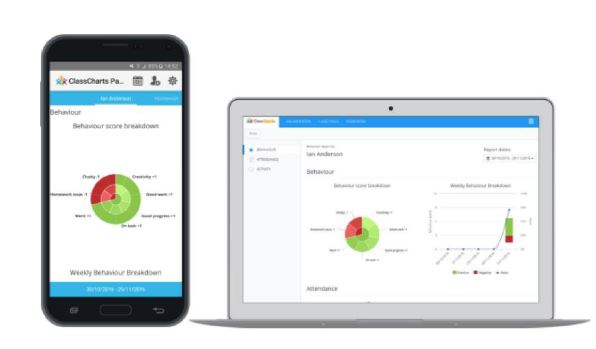
Class Charts is an online system, that enables teachers to record and communicate positive behaviour, as well as behaviour that falls short of our school rules. This information is then easily tracked within school as well as being instantly available to pupils, parents and carers.
All young people and families will be given a class charts account and a unique login so that class charts information can be accessed at any time.
This system allows us work in closer partnership with families, making it easier to share the successes of our young people as well as helping us work together, when things are not going as well.
Stepped Actions
Our Stepped Actions outline the way in which staff will respond to young people, should their behaviour fall short of our school community expectations of being Ready, Respectful and Safe.
At each point within the Stepped Actions, our aim will be to get the young person back to their learning as quickly as possible. We are also using the Stepped Actions to notify parents/carers, in a consistent way, when behaviour escalates beyond a “Last Chance Chat”. We believe that working in close partnership with our families is essential in supporting and encouraging the best from our learners and we thank you in advance for your support.
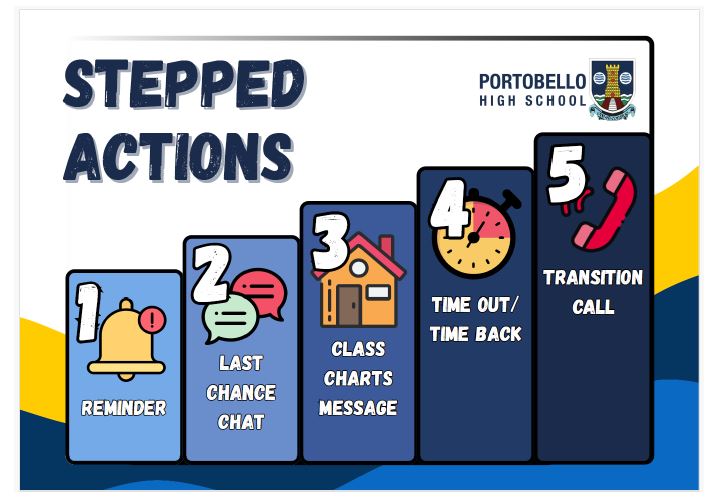
Step 1: Reminder
Purpose: To gently prompt students to refocus without escalating the situation.
Teacher Action: Reminding the young person of expectations and our rules of Ready, Respectful and Safe. The young person may be given a number of reminders and delivered in a way that allows the student to get back on track.
Examples:
- “Just a reminder, we’re working quietly right now”.
- “That’s not appropriate right now- let’s focus on the task, thank you”.
- “I need you to stop interrupting and listen when others are talking to the class”.
Step 2: Last Chance Chat
Purpose: To provide a clear opportunity for reflection before the concern is communicated home on Class Charts.
Teacher Action: Speak privately or discreetly to the student, outlining the concern and what needs to change. Make it clear this is their final chance to get back on track before a red on Class Charts.
Note: Where possible, this conversation should take place outside the classroom to provide a calm space for reflection. The discussion will be framed positively, encouraging the pupil to make a fresh start and re-engage with their learning.
Step 3: Class Charts Message
Purpose: To formally record the behaviour and communicate with home.
Teacher Action: Log the incident on Class Charts with a brief, factual note. This step signals that the behaviour has not improved and now requires parental awareness. These messages will be directed to the young person in order for them to reflect and make a positive change to their behaviour.
Example Entry:
- “I was disappointed that after a number of reminders you continued to disrupt the lesson. I look forward having you back in class next week and for you to be ready to learn”.
- “Unfortunately, your behaviour today was unsafe. We need to ensure everyone feels safe and secure in class. I know you can do better than this and look forward to you demonstrating that next lesson”.
- “Your language today in class was not respectful. We expect everyone to speak kindly and appropriately to others. I’m confident you can make better choices next lesson”.
Step 4: Time Out / Time Back
Purpose: To allow the learning and teaching to continue in the class. This may include the young person being moved to another learning space or another classroom. At this stage a time back will be set. A time back will provide a time to reflect with the teacher to ensure a positive start in the next lesson.
Teacher Action:
- Time Out – Direct the student to a designated time out space or another classroom.
- Time Back – This will be a short, structured restorative conversation- not a punishment. This conversation should restore the relationship and set clear expectations for a fresh start back into class. A Time Back will normally take place during a break or lunch the following day. A Time Back will be recorded on Class Charts to notify parents and pupil support.
Follow-Up: The young person will be reminded of the Time Back by a member of the pupil support team.
Step 5: Transition Call
Purpose: The Transitions Team may be called at this stage to help transition the young person to another area of the school. This may include helping a dysregulated young person to the Pupil Support Team, to another area of the department or school, or in more serious instances, to the Senior Leadership Team. Teacher Action: Contact the Transition Team for support. Provide a clear summary of situation, steps already taken and where the young person should be transitioned to.
Example:
- “Young person is refusing to go to Time Out space. Please can transition support”.
- “Young person is very dysregulated, please could the transition team support them to a support space”.
- “There’s been a serious incident, please could the transition team support the young person to SLT”.
Shared Roles & Responsibilities
Young People:
- Demonstrate the school’s core behaviours: Achievement, Resilience, Contribution.
- Follow the school rules: Ready, Respectful, Safe.
- Respond positively to reminders and feedback.
- Engage in Time Back conversations and reflect on behaviour choices.
- Use Class Charts to track progress and take ownership of their learning and conduct.
Parents & Carers:
- Support the school’s Positive Relationships Policy and reinforce expectations at home.
- Engage with Class Charts to monitor behaviour and celebrate achievements.
- Work in partnership with staff to support pupil reflection and improvement.
- Encourage attendance at Time Back or restorative meetings when appropriate.
Class Teachers:
- Build positive relationships through Meet & Greet, Calm & Kind interactions, and PIP & RIP.
- Apply Stepped Actions consistently, aiming to restore learning quickly.
- Use Class Charts to record behaviour and communicate with home.
- Lead Time Back conversations to repair relationships and set clear expectations.
- Maintain a calm, safe, and inclusive learning environment.
Curriculum Leaders:
- Support class teachers in implementing Stepped Actions within their subject areas.
- Monitor Class Charts data to identify patterns and provide targeted support.
- Ensure departmental consistency in behaviour expectations and responses.
- Liaise with SLT and Pupil Support regarding escalated concerns or repeated behaviours.
- Support Time Out spaces through faculty or collaborative based systems.
Transition Team:
- Respond to Transition Calls when a pupil needs to be transitioned from class due to dysregulation.
- Escort pupils safely to designated areas such as Pupil Support, another classroom, or SLT depending on the situation.
- Maintain calm and supportive interactions during transitions to reduce escalation.
- Support the reintegration of pupils back into class when appropriate.
- Record and track transition data to help identify patterns and inform future support strategies.
Pupil Support Officers:
- Remind pupils of scheduled Time Back conversations and encourage reflection.
- Ensure Time Backs are attended and signed off.
- Work closely with Pupil Support Leaders and families to provide tailored support for individual needs.
Pupil Support Leaders:
- Monitor behaviour trends across year group and work with DHT year head to celebrate and promote successes whilst developing interventions support strategies for areas of concern.
- If appropriate PSLs may support teaching staff and CLs with restorative conversations.
Respond to behaviour trends.
Support for Learning Leader:
- Overview of learning support plans
- Communication of Assessment Arrangements through Class Charts
Senior Leadership Team (SLT):
- Respond to serious incidents of concern.
- Support staff with escalated concerns and ensure appropriate follow-up actions are taken.
- Provide professional development and guidance to staff on relational and restorative practices.
- Work with Curriculum Leaders to monitor behaviour data trends and oversee strategic planning to improve school culture.
- Work with Curriculum Leaders to ensure our positive relationship policy is embedded in all areas across the school.
Referral Process
At Portobello High School, we are committed to ensuring that our systems for managing behaviour and support are clear, consistent, and efficient. To streamline processes and reduce duplication, Class Charts will now be used for all significant behaviour referrals. This replaces the previous SEEMiS referral process.
Using Class Charts allows for immediate communication, accurate tracking, and improved accountability. Once submitted, referral information is automatically shared with the relevant member of staff through an email notification.
When Class Charts Referrals will be used
A referral should be made through Class Charts when a significant concern arises — that is, where behaviour represents a serious breach of our school rules of being Ready, Respectful, and Safe, or where persistent behaviours have not improved despite the use of Stepped Actions.
Examples of incidents that may require a referral include (but are not limited to):
- Violent behaviour – physical aggression or harm toward another person.
- Abusive behaviour – verbal aggression, threatening language, or intimidation.
- Prejudice or discriminatory behaviour – including racism, sexism, homophobia, transphobia, ableism or any other form of discrimination.
- Consistent or sustained negative behaviour – repeated incidents where classroom interventions and
- Stepped Actions have not led to improvement.
Teachers should continue to apply Stepped Actions as outlined in the policy before making a referral, unless the nature of the incident is serious enough to bypass earlier steps.
How to Submit a Referral
- Staff should use Class Charts to record a Red behaviour with an accompanying note detailing the concern, this then forms the referral.
- Notes should be brief and factual outlining:
o the behaviour of concern
o actions already taken
o the support or follow-up being requested - To ensure clarity and accountability, referrals should only be directed to one person.
Flow of Referrals – To ensure appropriate escalation and support:
In the first instance:
- Class Teacher → Curriculum Leader (CL)
The class teacher records the incident and refers to the Curriculum Leader for follow-up, review, or additional support.
Further support required:
- Curriculum Leader → Depute Head Teacher (Year Head)
Where concerns persist, or where behaviour is serious or complex, the Curriculum Leader will refer the matter to the DHT for oversight and further action.
This process ensures a clear and traceable chain of responsibility, supports timely intervention, and avoids duplication of communication.
Monitoring and Accountability
Class Charts data will be monitored regularly by Curriculum Leaders, Pupil Support Leaders, and the Senior Leadership Team to identify trends, celebrate improvements, and ensure consistent responses across the school.
The use of Class Charts for referrals strengthens our whole-school approach to positive relationships — ensuring that behaviour management, communication, and follow-up are efficient, transparent, and aligned with our shared goal of Achieving Together.
